|
|
 |
 |
|
 |
HadrianAbstract
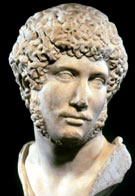
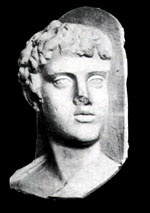
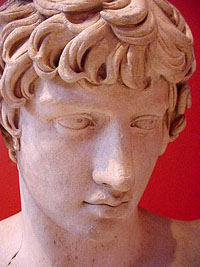
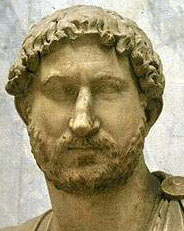
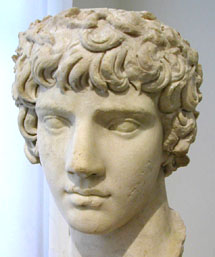
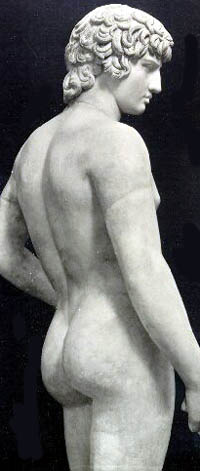
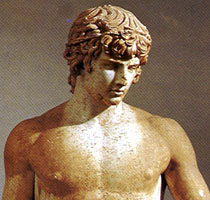
Hadrian (76 CE – 138 CE ), born in Spain of provincial Roman stock, became Roman Emperor in 117, succeeding to his uncle Trajan. Hadrian’s reign was marked by a distinct will to preserve the ‘Roman Peace’ and renunciation of further conquests, though towards the end of it he was forced to lead a disastrous war caused by a revolt in the province of Judaea, afterwards Palestine. He secured the frontiers with fortifications like Hadrian’s Wall in the north of Britain and the Limes in Germany. Hadrian spent most of his time far from Rome, indefatigably travelling through all parts of the vast Empire. His aim was to give the provinces more political importance and a stronger identification with the whole state. His concern for prosperity and welfare led to thorough-going reforms in administration, jurisdiction, education, taxation and the military, including, almost for the first time, some legal protection for slaves. Being an educated art lover, Hadrian designed himself some of the many buildings he decreed, most notably the still existent Pantheon in Rome, a bold and pioneering dome construction. His love of the Greek culture and history made Greece his favourite province, and particularly returned to Athens a touch of its gone glory, after a long stagnation and before a longer decay. The Greek tradition also afforded to Hadrian a model for his erotic inclinations. Though he doubtless had sexual relations to women too and did not think of himself as ‘homosexual’, a term unknown to the antiquity, it seems that males were more attractive to him. Certainly the person Hadrian loved most was a Greek youth named Antinous, who accompanied him about six years until the young man’s premature death in the Nile. Hadrian insisted on the deification of Antinous, though he had to know that the bestowal of such a distinction, usually reserved for deceased emperors and their family, on an obscure foreigner would not be appreciated in Rome. It was not the pederastic relationship in it itself that was offensive to the public opinion, though, but only the religious and political dimension that Hadrian gave to it. Hadrian had never been really popular in the Metropolis where the people felt neglected by his absence. When he returned to live there, he did not settle in Rome itself, but in the outskirts at the ‘Villa Hadriani’, a largeensemble of architectural dreams evoking
reminiscences of his travels. Besides, painful diseases, heart trouble and the dropsy, overshadowed his last years and caused less amiable traits of his nature to rise to the surface more frequently, such as a pedantic severity, rancour, hardness or even occasional cruelty, though the extent of his arbitrary actions was clearly exaggerated by hostile gossip. At any rate, his final decision to adopt Titus Aurelius Antoninus as his successor, obliging him to adopt on his part the young Marcus Annius, later known as Emperor Marcus Aurelius, proved a blessing for Rome, ensuring a few more decades of stable tranquillity. THE WHOLE STORY Publius Aelius Hadrianus was born in the year of 76 in the town of Italica in the south-west of Spain, a region that was then the Roman province Baetica, and is now known as Andalusia. Italica, with its full name ‘Colonia Victrix Italicensis,’ was founded in 205 BCE, after the Romans had conquered Spain from the Carthages, to become a home for veterans of that war. Hadrian’s ancestors were among the first settlers and remained belonging to the provincial gentry. Hadrian’s father gained the rank of a ‘praetor’ (senior magistrate mostly responsible for the adminstration of justice) and also won some glory and the cognomen ‘Afer’ in a minor military campaign in Africa. However, he had relations that were more distinguished: Marcus Ulpius Trajanus, married to a sister of the elder Hadrian’s father, commanded a legion in Judaea under Emperor Vespasian (69 - 79), and subsequently became consul in Rome and then governor of the province of Asia. His son of the same name followed his father’s footsteps and even managed to avoid the disgrace of Vespasians’s despotic son, Emperor Domitian. This Trajan became consul in 93.
Meanwhile, the reign of Domitian declined into terror and ended with the generally applauded assassination of the Emperor in the year of 96. Despite the nostalgia of a historian like Tacitus it was clear that there could be no return to the old republican government that had proved its inadequacy during the disintegration of the Roman state in the public disturbances and civil wars that endured for almost a century before the rule of Octavian Augustus restored peace and welfare. The Senate elected an aged honest man, Nerva, who with his frail state of health could not be expected to live long anymore. He adopted Trajan, who was then governor of the Roman province of Germany. Hadrian’s father had died when his son was ten years old, and Trajan had become one of his wardens. The boy was sent to Rome to complete his education, and it must have been during the five years of his stay there that he developed his life-long passion for the Greek language and culture which led him to the conviction that ‘what is said best is said in Greek’. Despite his zest for learning, Hadrian was no bookish fellow. He took a serious interest in music, poetry, painting, sculpture and architecture, all arts which he was to practise himself, he studied philology and mathematics, but he was also given to all kind of outdoor exercise, as a swimmer, horseman and hunter, and even as Emperor he marched on foot and in armour with the troops. After an interlude of two years in his home town, the seventeen-year-old Hadrian returned to Rome and, just having attained his majority, became judge at a probate court, which was unusually early also in that time. Fortunately he found a tutor in the excellent jurist Neratius Priscus, who later was his chief counsellor for the important law reforms that were enacted during Hadrian’s reign. The Roman tradition did not clearly distinguish between the civil and the military service, and so after only two years this very young judge was shifted to the army as a tribune, probably on his own wish. He served in two legions on the middle and lower course of the Danube, the eastern frontier of the Empire in Europe. After Emperor Nerva had adopted Trajan, the Fifth Legion sent Hadrian to bring his uncle their congratulations. Traian was then at Cologne on the Rhine, and, as it happened, Hadrian, while still on the road, heard of the death of Nerva. He managed to beat the official courier and be the first one to tell Trajan the news.
Trajan did not disapprove of his young nephew. Still they never were really close, owing to their different characters. Trajan was upright, simple and serene, sensible and of a shrewd instinct, frank and collected. Having no intellectual interests to speak of, he embodied many of the better qualities of the old Roman nature, but also much of its staleness. Hadrian was of inquisitive mind, restless, melancholy, whimsical for all his self-control, sensitive and demanding. Though the boozy conviviality seasoned with silly jokes that Trajan enjoyed could not be to Hadrian’s taste, he was doubtless wise enough to participate in it, and on the whole remained on good terms with his uncle. He served in his wars, but in between was entrusted with writing and delivering the Emperor’s addresses to the Senate. He was widely regarded as possible successor, but not officially confirmed as such. Trajan’s wife, Plotina, a cultivated woman, was soon resolved to pave the way for Hadrian. So she arranged his marriage to another one of Trajan’s relatives, a girl named Sabina. However, the couple did not go on well together, and their mutual indifference became open antipathy in later life, though they kept up appearances to some extent, and were never divorced. Sabina, who professed that she was proud to have born no children to her ‘monstrous’ husband, nevertheless was occasionally even allowed to accompany him on his travels. Trajan’s outstanding talent was that of a strategist and also his romanticism was a military one. There may have been security and economic reasons for the first war of his reign, the conquest of the Dacian kingdom, a belligerent state in the area of present Rumania. But it was hardly more than a caprice that Trajan, as a man of sixty, set out to copy the campaign of Alexander the Great, in attacking the realm of the Parthians, the powerful eastern neighbours of the Romans, in Mesopotamia and the Iran. After successful beginnings, it became clear that it was not possible to keep these new provinces. Besides, several revolts broke out in the whole Orient, and the loyalty of some Roman generals in the western parts of the Empire appeared questionable. Trajan started for Rome, but died in a port town of Asia Minor. The authenticity of his testament in favour of Hadrian was doubted. However, as governor of Syria Hadrian commanded the most substantial concentrated mass of the Roman army, and his enemies did not dare oppose him openly for the time being. So he was able to concentrate on reaching a peace settlement with the Parthians and to pacify the eastern provinces, which took him about a year. Then he set out for Rome. Meanwhile, Hadrian’s former warden Attianus, now prefect of the Guards, had discovered a conspiracy of four former ministers and generals of Trajan, all senators. They were captured and executed rather hastily, an arbitrary action that, though it was willy-nilly authorized by the Senate, could not really be approved of by the senators and roused much apprehension among the people too. So Hadrian, who was given a cold reception, did all he could to set the Senate at ease, dismissed Attianus honourably, and promised that he would adhere to legality. Besides he cancelled all debts owed by citizens to the state. He also decreed that the fortune of executed persons would no longer fall to the Emperor but devolve upon the treasury, because the former custom had been the pretext for a kind of disguised robbery slaying under greedy emperors such as Tiberius and Nero. Moreover, Hadrian increased a kind of children’s allowance introduced by Nerva, which was managed by a foundation that he controlled himself.
As Hadrian intended to leave the capital for long periods of travelling, he had to establish a trustworthy administrative body that would work reliably during his absence. Until then, the civil administration had been improvised rather than organized and mainly in the hand of liberated former slaves of the imperial chancellery, who were often notorious for their corruption and abuse of power. Hadrian abolished them and created a completely new Civil Service of citizens, not only from Rome and Italy but as far as possible from all provinces, with a defined hierarchy of secretaries and officials who received wages for the first time. Another momentous reform concerned the jurisdiction, which had been given to frequent changes, and on the whole was not very certain, because the supreme judges and the governors of the provinces were free to introduce new regulations when they declared the principles of law they would adhere to at the beginning of their yearly turns. Hadrian entrusted his new-founded Privy Council with the codification of the law, and after a decade of work the whole extent of the valid law was available in written form, and the right of adding changes and new laws restricted to the Senate and the Emperor. As for the army, though Hadrian did not plan to use it in wars, he knew very well that the Empire depended on its readiness and effectiveness, and that a long period of inaction was likely to weaken these qualities. Hadrian took quite severe measures against such risks, like regular hard training, restriction of leave, destruction of ‘pleasure villages’ near the garrisons. But as he left the pay on a comparatively high level, granted generous favours to the veterans which most soldiers became after twenty years of service, and cared very much for the troops, trying to know as many of them as possible personally, and always made a point of sharing their living conditions whenever he joined them, he was popular among them and could rely on their loyalty. Hadrian saw his own office as Emperor in quasi-military terms, as the first servant of the state, an attitude that derived from the Stoic philosophy and then found its classical expression in the reflections of Hadrian’s adopted grandson Marc Aurel. Hadrian had himself corresponded with and probably visited the philosopher Epictet (ca. 50-138), a former slave who taught a most austere Stoicism. However, Hadrian was both too much of an emotionalist and of too aesthetic a temperament to be satisfied with the mere morality of the Stoa, which besides offered nothing for spiritual needs. Other philosophical schools, like the one founded by Plato, were less one-sided, but mostly restricted to small circles. The religious situation of the time was characterized by a diminishing adherence to the traditional pagan gods both of Greece and Rome, largely identified, which failed to give sufficient solace in life and especially in death. For about a century sundry Egyptian and Oriental cults, such as of Cybele, of Mithras, of Isis and Osiris, had been flooding Rome, fascinating naive people as well as refined minds. Also Hadrian took a vivid interest in them, while he did not neglect the traditional rites of the sober old religion of the Romans, both for piety to the forefathers and reason of state. Undogmatic as all polytheism, the Roman religion did not claim exclusiveness and allowed a tolerance unknown to later (Christian) ages of spiritual totalitarianism. As long as anyone did not lack due reverence for the state, personal beliefs were of no consequence. Even the two Asian religions that because of their intransigent monotheism could not be integrated into the Roman world, Judaism and its scion Christianity, were only persecuted for their sedative dimension. At the time of Hadrian, Christianity was still a negligible quantity, and he followed Trajan’s tolerant politics towards Christians, as can be seen from his letter to a governor in Asia Minor: “Neither shall the innocent be troubled, nor shall slanderous informers have an occasion of enriching themselves. If our subjects in the provinces have proofs for their proceedings against the Christians, so that an ordinary court may be held, I am not opposed to them doing so. But I do not permit them thereby to rely only on idle talk. Because it is much more just that you, if anyone wants to bring action against the Christians, legally investigate what they are accused of. Therefore, if someone proves that the said people do something illegal, then you will punish them according to their offence; on the other side, by Hercules, you shall take care to proceed with severe punishment, according to his atrocious behaviour, against him who somehow brings action against Christians only to slander them.”
The case of the Jews was different. During the second century BC, Rome had supported the successful Jewish revolt against the Greek king of Syria, surely not disinterestedly. But since the first conquest of Jerusalem by Pompeius (63 BC), the people had been a part of the Roman Empire, but had never put up with it. From Alexander the Great on, Greeks had settled and founded cities and states in the whole Near East. Though the Hellenistic culture was formed as a blend of Greek and Oriental elements, the antagonism between the Greeks and the Oriental peoples was never fully overcome. The Jews were the least inclined to accept the Hellenistic way of life, though even they adopted the koiné the Greek language as it was spoken all around the Eastern Mediterranean, not only in Alexandria, where the Old Testament of the Bible was translated into Greek already in the third century BC. Though Rome did not hinder a Jewish Diaspora from spreading over the whole Empire, even granting them special rights according to their religion, the Romans were less tactful in Judaea itself. Frequent riots led to the first revolt in 66, which ended in the fall of Jerusalem in 70. The town was still mostly a heap of ruins sixty years later, when Hadrian came there, a situation that had to displease the great restorer. Unfortunately, his decision to build a new city on the ancient ground, called Aelia Capitolina and crowned by a temple of Jupiter instead of the former temple of Jehovah, proved a fatal blunder. He had the intention of finally integrating also the stubborn Jews into the Roman ‘Commonwealth’ of Hellenistic culture that was his vision, but he underrated the extent of their stubbornness. Many of the partly assimilated Jews living in Hellenistic towns like Alexandria had renounced the ritual circumcision, a custom considered especially barbarous and jeered at by the Greeks. Now Hadrian decreed that it was prohibited as a form of mutilation. It seems that this edict was the final cause for another revolt in Judaea that broke out in 131. The ensuing war was even worse than the one after the first revolt and ended with the expulsion of all surviving Jews from their country. Roman troops from most provinces had been transferred to Judaea. Their losses were so heavy that Hadrian, who had himself gone there, in his message to the Senate after the conquest of Jerusalem in 134, omitted the traditional formula: “If you and your children are well, it is all right; me and the army are well.” Hadrian was indeed not very well. He had reacted with merciless resolution when the Empire was at stake, but the programme of peace he had wanted his name to stand for was spoiled. Stricken with aggravating diseases, he returned to a capital he had never really liked, and where he was received with equal indifference. The outward reverence he showed for the Senate could not obscure the fact that it was only the Emperor who made all important political decisions. Besides the old-established urban families that had been suspicious of the stranger from the beginning resented his preference for the provinces. Moreover Hadrian had prosecuted all cases of bribery and embezzlement that he had come across on his travels. As such corruption had been an almost usual source of income for magistrates during their turns in the provinces, this set many of that class against him. Hadrian had also striven and considerably achieved to make Rome a less unhealthy place than it had been for the larger part of its inhabitants who were not rich. But they took it all for granted and were not grateful for the improvement of their living-conditions. Moreover, much as he cared for the welfare of the people, Hadrian had never been given to populism, so that he was not popular. The vast project of the ‘Villa’ at Tibur (now Tivoli) was not yet completed, but Hadrian stopped the work on it, preferring to spend his remaining time in the quiet surroundings of the place as it was. Even so it remains one of the most original monuments in the history of architecture and art, which influenced writers, artists, architects and landscape designers from the fifteenth century to the present. Hadrian’s goal was to create an arrangement of buildings which were functional and yet challenged the intellect to contemplate the unseen world. The most intimate building was a pavilion on an artificial island surrounded by a ditch amidst a circular arcade and a ring-wall, accessible only by a swing bridge. It was Hadrian’s favourite retreat where he would spend long hours alone, reading, writing or just dreaming. His autobiography which he wrote then has unfortunately been lost. The year of Antinous’s death, 130, appears to mark the beginning of Hadrian’s decline. The young Greek had accompanied him during his most active, energetic and successful time, from their meeting in Bithynia in 124 on, when the latter was 13 or 14,
Despite his increasing illness, Hadrian managed to rule efficiently also in his last years. In Rome he founded a kind of university, the Athenaeum. Nevertheless he was but a shadow of his former self, and had to think of a successor. Apparently his brother-in-law, Servianus, who was 90 years old but tenacious of life, hoped that he might be the Emperor’s heir. He was accused of conspiracy and executed together with his grandson. Afterwards Hadrian adopted Ceionus Commodus, whom he called Aelius Verus, and who was an easy-going and to all appearances not very promising man. Some loose tongues suggested that he owed his distinction to the favours he had once granted Hadrian, which could have hardly explained this preference, though. Instead it seems not completely unlikely that Verus was Hadrian’s son, but this also only surmise. However, Verus died of tuberculosis on New Year of 138, which was another blow to Hadrian. But his next choice turned out a better one, as he adopted Antoninus, then 51-year-old, a perfectly honest man, benign and even-tempered. He lacked Hadrian’s intellectual brilliancy and versatility, but also his restlessness and inconsistency. Antoninus Pius was to be Emperor for 23 years, during which he never left Italy. Hadrian had looked even farther forward and made Antoninus adopt his 16-year-old nephew, Marcus Annius Verus, who was to be the Emperor Marcus Aurelius, and also a Stoic philosopher famous for his ‘Meditations’. The ‘Antonine Age’ became a synonym for a time of peace and prosperity.
Animula vagula blandula CITATION: If you cite this Web page, please use the following form of citation: Editorial Board, World History of Male Love, "Famous Homosexuals", Hadrian, 2000 <http://www.gay-art-history.org/gay-history/gay-literature/famous-homosexuals/hadrian-antinous-gay/hadrian-antinous-gay.html> |
 |
  |
||||||||||||||||||||||||||||||||||||||||||||||||||||||||
|