|
Zeus and Ganymede - archaic Greek version
Zeus, the cloud-gathering father god, came down from shining Olympus and
begat Dardanus, who floated across the sea to the Hellespont on a raft made
of hides. There he begat Erichthonius, the first who dared harness four
horses to a chariot. He gathered a herd of three thousand mares, becoming
the richest of mortal men.
 |
|
|
|
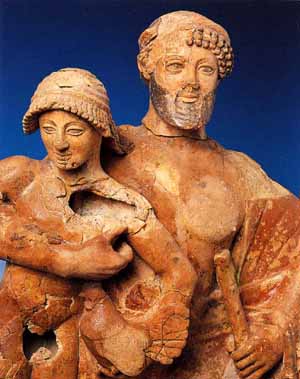
| Zeus Abducting Ganymede, ca. 470 BC, Polychromed terracotta acroterion from the Temple of Zeus at Olympia; Olympia Museum |
|
Erichthonius, in turn, sired Tros to be king
over the people. Tros took Callirrhoe to wife, daughter of sinuous
Scamander, river that waters the Trojan plain. In time, illustrious sons
were born to him: Ilus, builder of the famed city at the feet of Mount Ida,
and godlike Ganymede, the most handsome born of the race of men.
Fearing for the golden-haired boy's safety, Tros set stalwart guardians to
watch over his son. Ganymede played carefree with his friends, wrestling in
the sun and running in the wind, or chasing deer through the glades of
Mount Ida, for he was a hunter without peer.
Looking down from the heavens, the eye of wise Zeus lighted upon the
prince. Awestruck by the boy's beauty and eager to possess him, the god
unleashed a fierce thunderstorm, plunging the land into darkness.
Ganymede's friends and guardians scattered, racing for shelter. At that
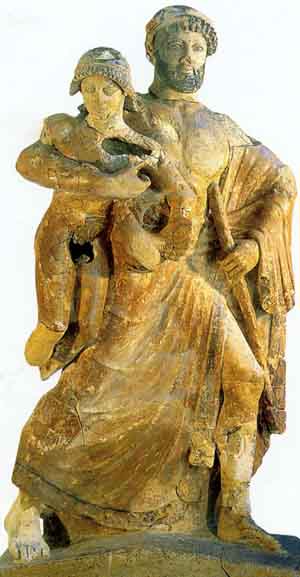
instant the god swept down unseen out of the clouds, gathered Ganymede up
in his arms and carried him away. Grief that could not be soothed filled
Tros' heart, for he knew not where the heaven-sent whirlwind had taken his
dear son.
|
|
 |
|
| Zeus Abducting Ganymede, ca. 470 BC, Polychromed terracotta acroterion from the Temple of Zeus at Olympia; Olympia Museum |
|
Zeus brought Ganymede to his crystal halls in Olympus. He made the radiant
youth deathless and appointed him cupbearer to the gods. It was his duty,
come feast time, to mull the red nectar in its great golden bowl, draw it
into a golden pitcher and fill each god's cup to the brim. The Olympians
all honored the young Trojan, for his beauty filled them with pure joy.
On earth, Tros pined for his son and mourned him constantly. At last, Zeus
took pity on the man. He hurried down Hermes, the divine messenger, with
rich gifts in payment for abducting Ganymede: an ever-fruiting golden vine,
and two high-stepping white mares. They were the finest that live and
prance under the dawn and the sun, the same that carry the immortals.
Heeding Zeus' command, Hermes revealed to Tros that his son was like a god
now, deathless and forever young. After receiving Zeus' tidings, Tros never
cried again. His heart was filled with joy and he happily drove his
storm-footed horses as fast as the wind.
To reward Ganymede, Zeus set him among the stars as Aquarius, the water
bearer. He stands there in the heavens, smiling still, bathed in soft
light, as the echo of his fame reverberates down the centuries.
Back to Zeus and Ganymede Reources
CITATION: If you cite this Web page, please use the following form of citation:
Andrew Calimach, World History of Male Love, "Gay History", Zeus and Ganymede - archaic Greek version, 2000 <http://www.gay-art-history.org/gay-history/gay-literature/gay-history/zeus-ganymede-analysis/zeus-ganymede-archaic-myth.html>
Bibliography
Anonymous, Homeric Hymn to Aphrodite 202ff.
Apollodorus, Library and Epitome iii.12.2
Euripides, The Trojan Women 820-840
Homer, Illiad 5.265ff.
Homer, Illiad 20.215-235
Hyginus, Poetica Astronomica II.29 Aquarius
Virgil, Georgics iii.
© 2003 Andrew Calimach
|
|
|