|
Zeus and Ganymede - Hellenistic version
Ganymede, the son of the Trojan king, had won great fame, but not in
battle, nor in the contests of strength. His shape alone had made him
famous, for he was most handsome of all men on this earth. Whenever he and
his friends took to the streets of Troy, Ganymede turned the heads of all
the townsfolk; men and women, all fell for his stunning, god-like beauty.
To keep him safe, the king set his guards to watch over the boy.
One day, Ganymede shed his clothes to bathe in the warm waters of the
Mediterranean. Looking down from the heavens the eye of father Zeus lighted
upon the prince, and the sight of the young Trojan's thighs instantly set
the god on fire with love. Hera, his wife, fumed in silence, her only
relief the thought that at least the youth was far away. But Zeus, heedless
of her jealousy, devised a plan to bring the boy to Olympus.
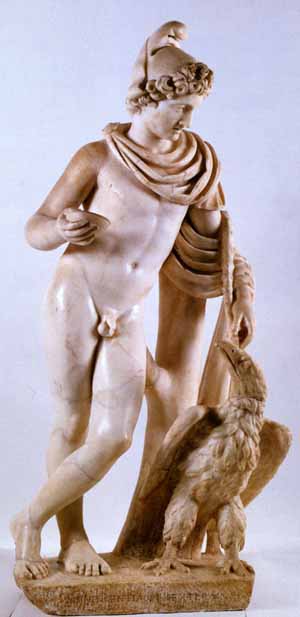 |
 |
|
| Zeus and Ganymede
Marble, 1st c. CE; Courtesy of the Chiaramonti Museum, Vatican
Rome |
First the god took the shape of an eagle. Then he unleashed a fierce
thunderstorm, plunging all Troy into darkness. Winging down into the black
clouds coiling about the city, the eagle sent shafts of lightning stabbing
every which way. Ganymede's friends and guardians raced for shelter,
falling over each other in their haste. Amid the turmoil, the eagle swooped
out of the clouds and pounced upon the awestruck boy. It set him astride
its back and launched itself once more upon the wind. The guardians raced
back to save the prince, but the eagle beat the air with powerful wings
once, twice, and the storm swallowed them up.
They flew beyond the clouds, lost themselves into the deep blue sky, and
the boy clung in wonder to his plumes. At last the eagle set down, folded
its wings, and Ganymede found himself amidst the crystal halls of Olympus.
A god once more, Zeus wrapped a friendly arm around his shoulder, looked
him in the eye, and let him know that from now on he would walk among the
immortals.
In vain Hera protested that Ganymede gave nothing she could not offer, that
her beauty behind fully equaled her beauty in front. Zeus tumbled again and
again in bed with the curly blond prince, and Ganymede paraded around with
a perpetual grin on his face. Before long, he and Eros, the youngest of the
gods, became fast friends. Every chance they got, the boys went off by
themselves, casting dice for hours on end. But greedy Eros was way too sly
a player – he beat Ganymede every time, left him penniless and in tears.
To make room in Olympus for his boyfriend, Zeus turned on Hebe, Hera's
daughter, who had always served the gods at table. He claimed she stumbled,
mocked her for being clumsy and sent her packing. At feast times it was
Ganymede now who mulled the red nectar and filled each god's cup to the
brim. And on coming round to Zeus, he would first plant a kiss on the rim
of the chalice before handing it back to his loving lord.
Hera was livid with rage. She turned on Zeus, berating him for bringing
that horrid long-haired mortal to Olympus. Her husband threw in her face
that he liked the boy's kisses best, and bestowed immortality on his
beloved. Now Ganymede was like a god, forever young.
Seething with jealousy, Hera hungered for revenge. Unable to harm Ganymede
she went after his people instead. She fanned the flames of war and, in
the end, all Greece rose up and massacred the Trojans. But Ganymede himself
was beyond her reach. Zeus had set the boy among the stars—as Aquarius, the
water bearer, shielding him forever under the wings of the Eagle.
Back to Zeus and Ganymede Reources
CITATION: If you cite this Web page, please use the following form of citation:
Andrew Calimach, World History of Male Love, "Gay History", Zeus and Ganymede - Hellenistic version, 2000 <http://www.gay-art-history.org/gay-history/gay-literature/gay-history/zeus-ganymede-analysis/zeus-ganymede-hellenistic-myth.html>
Bibliography
Apollonios Rhodios, Argonautica III 115-127
Diodorus Siculus, Histories 4.75.3
Euripides, Iphigenia in Aulis
Euripides, The Trojan Women 820-840
Hyginus, Poetica Astronomica II.16 Eagle, II.29 Aquarius
Martial, Epigrams XI 43
Ovid, Metamorphoses 10.155ff.
Sophocles, The Colchian Women (after Athenaeus, 602)
First Vatican Mythographer, Ganymede 184
Second Vatican Mythographer, 198
Virgil, Aeneid 5. 252 - 260
© 2003 Andrew Calimach
|
|
|