|
|
 |
 |
|
 |
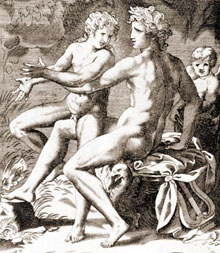
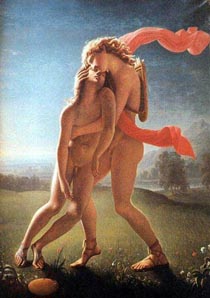
Apollo and Hyacinth
Once, in the heat of a summer afternoon,
the lovers stripped naked, sleeked themselves with olive oil, and tried their
hand at discus throw, each vying to outdo the other. The bronze
discus flew higher and higher. Finally, the powerful god gathered
all his strength, and spun and wheeled and let fly the shiny
disk which rose swift as a bird, cutting the clouds in two. Then,
glittering like a star, it began to tumble down. Horrified, Apollo raced over. He bent over
his friend, raised him up, rested the boy's head on his knees,
trying desperately to staunch the blood flowing from the wound.
But it was all in vain. Hyacinth grew paler and paler. His
eyes, always so clear, lost their gleam and his head rolled to
one side, just like a flower of the field wilting under the pitiless
rays of the noonday sun. Heartbroken, Apollo cried out: "Death
has taken you in his claws, beloved friend! Woe, for by my own
hand you have died. And yet its crime was meeting yours at play.
Was that a crime? Or was my love to blame - the guilt that follows
love that loves too much? Oh, if only I could pay for my deed
by joining you in your journey to the cheerless realms of the
dead. Oh, why am I cursed to live forever? Why can't I follow
you?"
Apollo held his dying friend close to his breast,
and his tears fell in a stream onto the boy's bloody hair.
Hyacinth died, and his soul flew to the kingdom of Hades. The
god bent close to the dead boy's ear, and softly whispered:
"In my heart you will live forever, beautiful Hyacinth.
May your memory live always among men as well." And lo,
at a word from Apollo, a fragrant red flower rose from Hyacinth's
blood. We call it hyacinth, and on its petals you can still
read the letters "Ay," the sigh of pain that rose from
Apollo's breast. Comments on the Concepts of Gay and Homosexual: The book The Gay Greek Myths restores the homosexual and homoerotic content of the Greek myths. But Gay Greek Myths, indeed "gay mythology" in general, is a misnomer. "Gay" as a sexual identity is a recent development, emerging only in the 20th Century and our idea of what it means to be gay or a homosexual has largely been influenced by recent gay activism and the emergence of gay rights on the cultural landscape. In the time of the Greeks there was no such identity as gay - or straight - and they did not compartmentalize their sexuality into homosexual and heterosexual. Their homosexual passions were part of their erotic expression as sexual beings. They would not have considered their love for boys as gay or homosexual, as separate from other sexual expressions, and the worth of the relationship was judged not by the gender of the person one loved, but by its results. Nevertheless, throughout this site you will see the use of the words gay, homosexual and homosexuality when referring to ancient practices. Indeed this very section is titled "Homosexual Greek Myths." This is done for practical purposes, so we can easily describe the sexual relations of the ancients with familiar vocabulary. Things, however, were much more complex then the words might indicate. Mythographer's Comments These Greek myths are based quite closely on ancient fragments, materials until now passed over by modern mythographers. The sources range from poets to historians to playwrights and early Christian polemicists. Thus the form of the stories should be seen as a late one, incorporating in many cases Roman sensibilities. Of course there has never been any one "true" version of any of these stories, as they were told and retold over a span of at least two thousand years across a region ranging across three continents, from the Black Sea to the shores of North Africa, an area now occupied by such countries as Bulgaria, Greece, Turkey, Egypt, Italy and others. Nonetheless, the myths collectively reflect a world view in which male love was wholly compatible with living life in a sacred way, a path to heroism and divinity. CITATION: If you cite this Web page, please use the following form of citation: Greek Mythology Home |
 |
|
|||||||||||||||||||||
|