 |
|
 |
 |
|
 |
Zeus and GanymedeErichthonius, the first to ever harness four horses to a chariot, was the richest of mortal men. He had a son named Tros, lord of the Trojans, and to him in turn were born three unblemished boys: Ilus founder of Ilium, Assaracus, and god-like Ganymede – the handsomest ever born of the human race. Tros loved Ganymede from the bottom of his heart and set guardians and tutors to watch over him as he wrestled, or rode to the hounds, or swam through the crashing, dragging breakers of the warm Mediterranean. One day, looking down from his throne on Mount Olympus, Zeus spied Ganymede up in the meadows of Mount Ida, chilling with his friends under the watchful gaze of his aged tutors. Instantly, the King of Heaven flamed with love for the young Trojan’s thighs. Zeus shook himself once and turned into a powerful eagle. Straightaway he swooped down upon the world of men. Casting shafts of lightning every which way, he whipped up a fierce tempest turning day into night. Under cover of the storm the majestic eagle pounced and tenderly seized the boy in his talons. The aged guardians reached out to stop him, the hounds barked madly. Paying them no heed, the god and the boy rose up higher and higher and vanished into the blue. 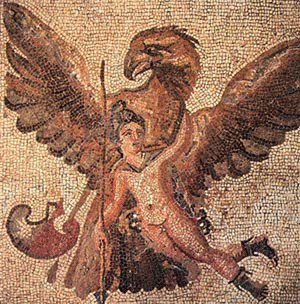
Watch a video of the Zeus and Ganymede Myth: Comments on the Concepts of Gay and Homosexual: The book The Gay Greek Myths restores the homosexual and homoerotic content of the Greek myths. But Gay Greek Myths, indeed "gay mythology" in general, is a misnomer. "Gay" as a sexual identity is a recent development, emerging only in the 20th Century and our idea of what it means to be gay or a homosexual has largely been influenced by recent gay activism and the emergence of gay rights on the cultural landscape. In the time of the Greeks there was no such identity as gay - or straight - and they did not compartmentalize their sexuality into homosexual and heterosexual. Their homosexual passions were part of their erotic expression as sexual beings. They would not have considered their love for boys as gay or homosexual, as separate from other sexual expressions, and the worth of the relationship was judged not by the gender of the person one loved, but by its results. Nevertheless, throughout this site you will see the use of the words gay, homosexual and homosexuality when referring to ancient practices. Indeed this very section is titled "Homosexual Greek Myths." This is done for practical purposes, so we can easily describe the sexual relations of the ancients with familiar vocabulary. Things, however, were much more complex then the words might indicate. Mythographer's Comments These Greek myths are based quite closely on ancient fragments, materials until now passed over by modern mythographers. The sources range from poets to historians to playwrights and early Christian polemicists. Thus the form of the stories should be seen as a late one, incorporating in many cases Roman sensibilities. Of course there has never been any one "true" version of any of these stories, as they were told and retold over a span of at least two thousand years across a region ranging across three continents, from the Black Sea to the shores of North Africa, an area now occupied by such countries as Bulgaria, Greece, Turkey, Egypt, Italy and others. Nonetheless, the myths collectively reflect a world view in which male love was wholly compatible with living life in a sacred way, a path to heroism and divinity. CITATION: If you cite this Web page, please use the following form of citation: |
 |
|
|


